The Rise of the “RE–” Parties
(Reform, Restore, Reclaim — and the broader Re- prefix movement)
This is structurally rich territory.
No sub judice risk.
No speculation.
Pure systems analysis.
We’re not analysing whether they’re right.
We’re analysing how they rise.
Step 1 — The Prefix Pattern
Notice something obvious in hindsight:
Re-form
Re-store
Re-claim
The prefix “Re” signals:
• Return
• Correction
• Restoration
• Recovery
It implies:
Something was lost.
Something was taken.
Something was broken.
This is Narrative Gravity before any policy is discussed.
The branding itself encodes a story:
“There was an original state of order.”
That is powerful.
It activates nostalgia and grievance simultaneously.
Step 2 — Drift
What has drifted?
• Sovereignty
• Identity
• Cultural norms
• Economic security
• Institutional trust
Whether those shifts are real, perceived, exaggerated, or misattributed is secondary.
Drift perception is enough.
Tradecraft observation:
The rise of RE- parties correlates strongly with perceived drift — not necessarily measured decline.
Perception matters structurally.
Step 3 — Momentum
Once one RE- party gains traction:
• Media amplification increases
• Poll numbers get reported
• “Surge” becomes headline language
• Tactical voting conversations begin
Momentum builds not just from support — but from reporting about support.
Repetition creates inevitability framing.
“Rising force.”
“Political earthquake.”
“Breaking the two-party system.”
Language accelerates.
Step 4 — Incentive Mapping
Why are these parties amplified?
Media incentive:
They generate conflict.
Conflict generates engagement.
Mainstream party incentive:
They can be used as contrast warnings.
Or wedge pressure tools.
Supporter incentive:
Identity restoration.
Moral clarity.
Belonging.
Political incentive:
Disruption attracts attention in crowded systems.
You don’t need conspiracy.
You need incentive alignment.
Step 5 — Compression
Policy detail collapses into:
“Take back control.”
“Restore order.”
“Free speech.”
“Protect Britain.”
Each is emotionally legible.
Each is structurally compressed.
The more complex the problem, the more attractive the compression.
Tradecraft question:
If expanded, what do these mean operationally?
Step 6 — Substitution
Watch the language shifts.
Criticism becomes:
“Elites silencing dissent.”
Policy disagreement becomes:
“Betrayal.”
Regulation becomes:
“Control.”
Opposition becomes:
“Censorship.”
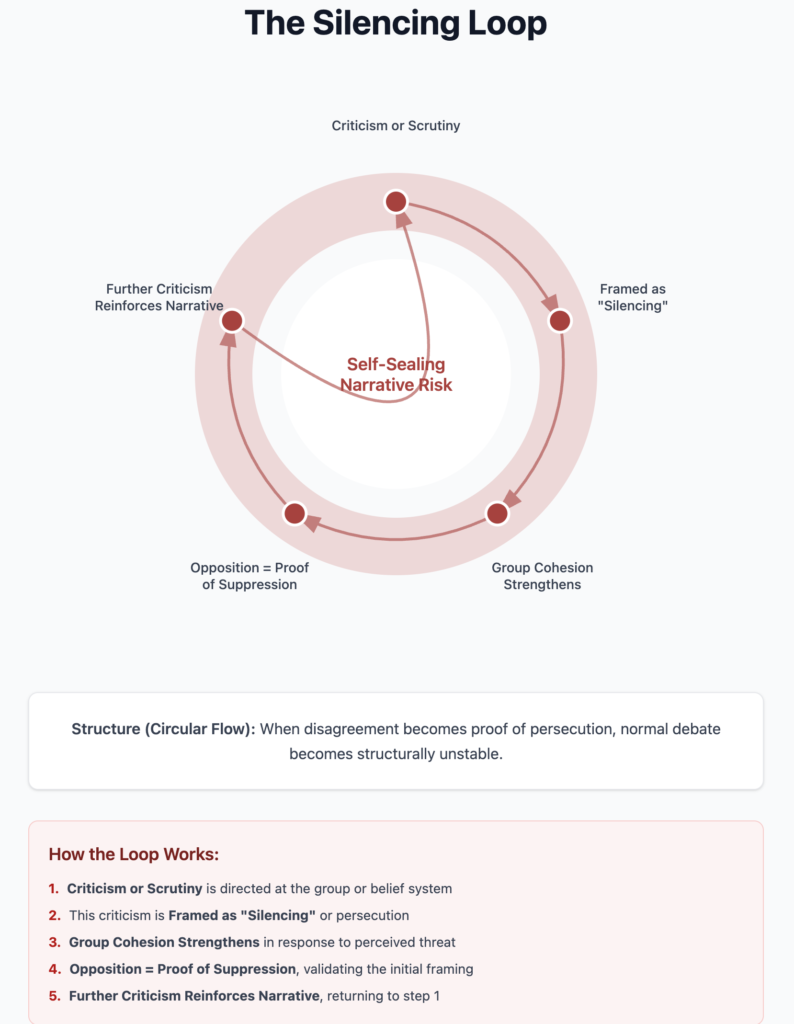
“Silencing” frame
Disagreement → “They’re trying to silence us.”
Moderation / standards / scrutiny → “Censorship.”
Institutional checks → “Suppression.”
Accountability → “Persecution.”
Why it matters: it converts any criticism into proof of persecution, which makes the narrative self-sealing
Each substitution increases moral temperature.
Step 7 — Calibration
Now the hard part.
Do these parties reflect:
A) Structural democratic correction?
B) Cyclical protest dynamics?
C) Media amplification bias?
D) Genuine ideological shift?
Foreign / external money & influence vectors (risk, not assumption):
- Donations / loans / “services” routed via intermediaries
- Think tanks, consultancies, “policy platforms,” data firms
- Paid media appearances / sponsorship ecosystems
- Dark-money style structures (where legal) vs disclosure regimes (where required)
Tradecraft framing: not “they’re funded by X,” but “what would we expect to see if they were?”
Then look for those indicators.
Tradecraft does not choose emotionally.
It asks:
What proportion of each is present?
Confidence should match evidence.
Not volume.
Step 8 — Narrative Gravity (Most Important)
These parties don’t emerge in isolation.
They emerge within broader narratives:
• Institutional distrust
• Globalisation fatigue
• Post-pandemic dislocation
• Cultural fragmentation
• Economic pressure
Narrative Gravity + cult of personality
Add this as a distinct gravity source:
Leader-as-symbol effect
- The leader becomes the “proof of concept”
- Criticism of leader becomes criticism of “the people”
- Policy becomes secondary to identity alignment
- Loyalty becomes a political currency
That turns a party from a platform into a social container.
The “old people want their youth back” effect
Yes — this has names in psychology, and it’s basically two linked effects:
- Rosy retrospection: past periods feel better than they were.
- Reminiscence bump: people disproportionately remember ages ~10–30 as vivid/defining, so “the good old days” often map onto their youth, not a measurable golden era.
Tradecraft use: it’s not an insult, it’s an explanatory lens. It predicts why “restore” language lands harder with older cohorts.
If you only look at the party, you miss the gravitational field.
If you only look at the field, you miss the organisational vehicle.
Both matter.
Structural Insight
The RE- pattern is not random.
It signals:
Restoration politics.
Restoration politics rise when:
• Drift perception exceeds trust
• Momentum outpaces nuance
• Incentives reward disruption
• Compression beats complexity
This is not endorsement.
Not dismissal.
It is mapping.
Restoration Politics
UK RE– Parties vs US MAGA (Structural Comparison)
This page does not analyse whether these movements are right or wrong.
It analyses how they function.
Political movements that promise to “restore” something tend to emerge during periods of perceived drift — cultural, economic, institutional, or generational.
The UK RE– parties and the US MAGA movement share structural features.
They also operate in very different cultural and constitutional environments.
Understanding both similarities and differences prevents false equivalence.
1. The Compressed Promise
| Structural Feature | UK RE– Parties | US MAGA |
|---|---|---|
| Core framing | Restore / Reform / Reclaim | Make America Great Again |
| Implied narrative | Something was lost or taken | Something was lost or betrayed |
| Direction of travel | Return to institutional order | Return to national strength |
| Emotional anchor | Recovery | Revival |
Both rely on compressed language.
Compression increases emotional clarity.
It reduces policy complexity.
Tradecraft question:
If expanded, what does the slogan operationally mean?
2. Sovereignty Framing
UK Context
Sovereignty debates tend to focus on:
• Parliament vs courts
• International treaties
• Regulatory frameworks
• Immigration control
Sovereignty is framed as decision-making authority.
US Context
Sovereignty debates often focus on:
• Federal vs state power
• “Deep state” institutions
• Cultural authority
• Border control
Sovereignty is framed as control over institutions and identity.
Shared structure:
Sovereignty becomes shorthand for control.
Key difference:
The UK operates under parliamentary supremacy.
The US operates under a constitutional separation of powers with a presidential executive.
The institutional pressure points differ.
3. The “Silencing” Loop
A shared mechanism in restoration movements:
Disagreement becomes “silencing.”
Scrutiny becomes “censorship.”
Regulation becomes “control.”
Opposition becomes “persecution.”
This is structurally powerful because it:
• Converts criticism into validation
• Reinforces group cohesion
• Raises moral temperature
The mechanism is similar in both countries.
The cultural expression differs.
4. Election Legitimacy Narratives
US
Election fraud claims became central after 2020.
The legitimacy of the electoral process itself became a core identity issue.
UK
While distrust of institutions exists, verified fraud cases remain statistically low.
Legitimacy narratives more commonly focus on:
• Media bias
• “Establishment stitch-ups”
• Unelected bodies
Structural similarity:
Legitimacy doubt increases cohesion.
Structural difference:
The US presidential system magnifies election centrality.
The UK parliamentary system distributes legitimacy across party structure.
5. Leader Centrality (Cult of Personality Risk)
Restoration movements often become leader-centric.
In the US:
The presidency amplifies personalism.
The leader becomes synonymous with the movement.
In the UK:
Party structure and parliamentary constraints reduce — but do not eliminate — leader centrality.
Structural risk:
When policy becomes secondary to personality, structural checks weaken.
Tradecraft check:
Does criticism of the leader become criticism of “the people”?
If yes, personalism is active.
6. Incentive and Foreign Interest Risk
In highly polarised systems, disruption attracts:
• Attention
• Funding
• Media amplification
• External influence attempts
This does not prove interference.
It defines vulnerability.
Indicators to monitor:
• Opaque funding structures
• Intermediary think tanks
• Data services tied to political messaging
• Disproportionate amplification by foreign-aligned networks
Tradecraft does not assume.
It asks what would be visible if influence existed.
7. Generational Dynamics
Restoration language often resonates more strongly with older demographics.
Psychological research identifies:
• Rosy retrospection
• The reminiscence bump (ages ~10–30 disproportionately shape perceived “golden eras”)
This does not invalidate concern.
It explains distribution of support.
The past often feels better because it coincides with youth.
8. Cultural Architecture: UK vs US
The United States and the United Kingdom share language.
They do not share political culture.
The US political style is:
• Explicit
• Declarative
• Identity-forward
• Litigation-driven
The UK political style has historically been:
• Ironic
• Indirect
• Institutionally mediated
• Satirically self-correcting
Sarcasm and understatement function differently across audiences.
Messaging strategies imported without cultural calibration can distort meaning.
Political frames that resonate in the US may not translate cleanly in the UK.
Tradecraft principle:
Never assume identical language means identical political structure.
Forcing US-centric political dynamics into UK institutional culture risks destabilisation.
Structural Summary
Shared Mechanisms:
• Compression of complex policy into symbolic language
• Sovereignty framing
• Silencing loop activation
• Incentive amplification
• Leader centrality risk
• Nostalgia anchoring
Structural Differences:
• Constitutional framework
• Media ecosystem scale
• Institutional trust baselines
• Cultural communication style
Restoration movements emerge when perceived drift exceeds institutional trust.
They gain traction when compression beats complexity.
They stabilise when narrative cohesion outweighs procedural doubt.
They destabilise when personalism overwhelms structure.
Tradecraft Application
The correct question is not:
“Are they right?”
It is:
What structural conditions are they responding to?
What mechanisms are they using?
What vulnerabilities exist?
What would falsify their core claims?
If the answers are proportionate, clarity improves.
If they are not examined, momentum substitutes for reasoning.