Case Study 3
“Does the UK Have a Free Speech Problem?”
The Claim
You will hear two very different stories.
One says:
Britain is sliding into censorship.
The other says:
Britain simply enforces reasonable protections against harm.
Both can’t be fully right.
So instead of picking a side —
we examine structure.
Step 1 — What Does the Law Actually Say?
Freedom of expression is protected under Article 10 of the European Convention on Human Rights.
But Article 10 also allows restrictions “necessary in a democratic society.”
The Online Safety Act 2023 includes duties to protect freedom of expression Free speech.
At the same time, it imposes broad duties on platforms to mitigate harm — especially toward children.
The tension is visible in the statute itself.
Step 2 — How Is It Enforced?
Recent analysis reports:
- Over 30 arrests per day for online communications offences
- 13,200 non-crime hate incidents recorded annually
- Up to 60,000 police hours spent investigating such incidents Does the U.K. Have a Free Speec…
The question is not:
Are these numbers large?
The question is:
What proportion lead to prosecution?
What thresholds were applied?
What definitions were used?
Structure matters more than outrage.
Step 3 — What Do People Feel?
A nationally representative Ipsos survey (N=2,291) commissioned by the Commission for Countering Extremism found measurable levels of self-reported reluctance to express views on sensitive topics.
This does not prove censorship.
It does indicate perceived constraint.
Perception shapes behaviour — even when law does not demand silence.
Step 4 — Where Does Risk Actually Sit?
The most important issue may not be censorship.
It may be ambiguity.
When legislation uses broad phrases such as:
- “Grossly offensive”
- “Likely to cause distress”
- “Glorifying terrorism”
- “Harmful content”
Interpretation moves from Parliament to regulators, police, and courts.
That shift is subtle.
But structurally significant.
What This Case Shows
The debate is not:
Freedom vs Safety.
It is:
Clarity vs Discretion.
The more elastic the language,
the more power shifts from statute to interpretation.
Whether that becomes abuse depends on:
• Oversight
• Transparency
• Proportionality
• Cultural norms
Tradecraft does not declare Britain censored.
It asks:
Are definitions clear enough that ordinary people know where the line is?
If you are sure you’ve considered everything,
the rest is up to you.
Freedom of Expression Survey — Extracted Findings
Source: Ipsos UK KnowledgePanel, N = 2,291 190625 FoE Survey FINAL
1️⃣ Overall Principle Support
The survey shows:
Strong general support for the principle of free speech across social, political and religious topics 190625 FoE Survey FINAL
However:
A notable segment believes free speech is not adequately protected in England and Wales today 190625 FoE Survey FINAL
Important structural nuance:
Respondents often prioritised:
• Freedom from threats
• Freedom from discrimination
Above absolute free speech 190625 FoE Survey FINAL
This indicates:
The public does not treat speech as an isolated right.
It weighs it against harm.
2️⃣ Political Views — What People Think Others Should Be Allowed to Say
Percentage who think people should be able to say what they want (score 1–3):
- Centre-left ideas: 56%
- Centre-right ideas: 51%
- Far-left ideas: 49%
- Far-right ideas: 40% 190625 FoE Survey FINAL
Those who think people should be careful not to offend (score 5–7):
- Far-right ideas: 33%
- Far-left ideas: 21%
- Centre-right ideas: 19%
- Centre-left ideas: 14% 190625 FoE Survey FINAL
Structural insight:
Support for free speech declines as perceived extremity increases — particularly for far-right ideas.
3️⃣ Personal Ability to Speak
Across political topics:
55% say they personally feel free to express their own political views (score 1–3) 190625 FoE Survey FINAL
Demographic differences:
More likely to feel free:
• Younger and older age groups
• Men
• White respondents
• Graduates
Less likely to feel free:
• Middle-aged individuals
• Ethnic minorities
• Religious individuals 190625 FoE Survey FINAL
Important:
Even groups feeling “less free” still more often reported feeling able to speak than not.
This suggests:
Variation in comfort — not uniform suppression.
4️⃣ Sensitive Topics
Race and ethnicity stood out as the area where a plurality prioritised avoiding offence over free speech 190625 FoE Survey FINAL
Climate change and general politics received strongest support for open expression 190625 FoE Survey FINAL
Religious topics showed variation depending on the religion discussed 190625 FoE Survey FINAL
5️⃣ Reasons People Hold Back
The survey explicitly reports:
Primary reasons people refrain from expressing views:
• Avoid causing offence
• Avoid starting an argument 190625 FoE Survey FINAL
This is crucial.
The dominant self-restraint driver is social dynamics, not necessarily legal fear.
6️⃣ “Most Concerned About Pace of Change” Subgroup
This group:
• Express stronger concern about protection of free speech
• More likely to favour speech regardless of topic
• Particularly strong regarding immigration, asylum, race/racism, religious extremism 190625 FoE Survey FINAL
This group skews:
• Older
• Male
• White
• Non-graduate
• Christian 190625 FoE Survey FINAL
This aligns structurally with demographic support patterns in broader political polling.
What the Survey Actually Shows (Clean Summary)
It does NOT show:
• Majority feeling silenced
• Broad collapse of speech
• Legal fear dominating
It DOES show:
• Strong support for principle of speech
• Clear topic-based sensitivity
• Demographic variation in comfort levels
• Social self-censorship more common than legal fear
The Broadcast Illusion Problem
(New structural section for Case Study 3)
This is not law.
This is not ideology.
This is cognitive scale distortion.
The Broadcast Illusion
For most of human history, speech operated at three levels:
- Private conversation
- Small group discussion
- Public speech (rare, visible, accountable)
Social media collapses these.
Now a person can:
- Type a sentence emotionally
- Press send
- Instantly broadcast to millions
- Be legally treated
CCE / IPSOS 2025 – CLEAN FINDINGS DIGEST
(England & Wales, 16+, n ≈ 2,291) 190625 FoE Survey FINAL
0. What This Survey Actually Is
Commissioned by: Commission for Countering Extremism (CCE)
Fieldwork: 27 Feb – 5 March 2025
Method: Ipsos UK KnowledgePanel (probability-based panel)
Sample: Representative of England & Wales, with Muslim booster sample 190625 FoE Survey FINAL
Important:
This is not a “prove speech is under threat” survey.
It is designed to examine:
• Attitudes to free speech
• Differences across demographics
• Reasons people refrain from expressing views
That third bullet is key.
1️⃣ PRINCIPLE VS PRACTICE GAP
Across most modern speech surveys (including this one’s design brief 190625 FoE Survey FINAL):
People strongly endorse:
“Freedom of expression is important.”
But when topics become:
• Religion
• Immigration
• Race
• Gender
• Security
• National identity
Support becomes conditional.
This gap is foundational.
Tradecraft note:
This is not hypocrisy.
It is harm-balancing.
2️⃣ PERSONAL RESTRAINT (SELF-CENSORSHIP)
The survey explores:
Reasons individuals might refrain from expressing views. 190625 FoE Survey FINAL
This measures:
• Social caution
• Workplace caution
• Online caution
• Fear of consequences
• Fear of reputational damage
Important distinction:
Refraining from speaking ≠ being prohibited from speaking.
Most modern democracies show:
Moderate levels of self-restraint.
Low levels of formal prohibition.
This is normal in plural societies.
3️⃣ CONTEXT MATTERS
Speech comfort differs depending on:
• Talking to friends
• Talking at work
• Posting online
• Discussing politics
• Discussing religion
The survey explicitly examines topic-based differences 190625 FoE Survey FINAL
This is essential.
Because:
A country can have:
High overall free speech support
AND
High discomfort on specific topics.
Those are not contradictions.
4️⃣ SECOND-ORDER PERCEPTION
The study examines:
Public perceptions of freedom of expression 190625 FoE Survey FINAL
This includes climate perception.
This is critical.
There are three layers:
Layer 1 – What I believe
Layer 2 – What I say
Layer 3 – What I think others can say
Often:
Layer 3 is more pessimistic than Layer 1.
That creates:
Spiral of silence dynamics.
5️⃣ DEMOGRAPHIC SPLITS
The survey examines differences across:
• Age
• Religion
• Political alignment
• Gender
• Ethnicity 190625 FoE Survey FINAL
Typical pattern (seen in similar studies):
• Younger cohorts – more cautious on harm-sensitive topics
• Older cohorts – more concerned about “political correctness”
• Minority religious groups – more sensitive to religious offence
• Majority groups – more concerned about institutional restrictions
These splits fuel political narratives.
But they do not equal systemic censorship.
6️⃣ WHAT THE SURVEY DOES NOT SHOW
This is important.
It does not show:
• Government banning speech en masse
• Mass arrests for political opinions
• Institutional silencing as a measurable epidemic
It shows:
Attitude tension.
Perceived risk.
Contextual caution.
Those are not the same as authoritarian suppression.
7️⃣ ONLINE FACTOR (Your earlier point)
The survey includes attitudes across topics 190625 FoE Survey FINAL
But what it does not deeply capture is:
The psychological scale shock of:
Broadcasting to millions.
Here is the structural problem:
Humans evolved for:
Small group conversation.
Online platforms created:
Permanent global broadcast.
People still behave as if:
They are speaking to five friends.
But they are:
Speaking to employers, activists, algorithms, adversaries, archives.
That mismatch increases:
• Fear
• Misinterpretation
• Outrage cycles
• Caution
This is not censorship.
It is environment shock.
And it is new.
Interim Assessment (Evidence Strength)
Based on structure and methodology:
Strong evidence for:
• Social caution
• Topic-based restraint
• Demographic perception gaps
• Climate sensitivity
Weak evidence for:
• Formal state suppression
• Systemic legal silencing
That is where evidence is strongest.
Survey Engineering & Narrative Production
(Stacked Analysis: Academic → Tradecraft → Case Comparison)
LAYER 1 — ACADEMIC STRUCTURAL ANALYSIS
This layer asks:
What is being measured?
How is it being measured?
What cognitive mechanisms are activated?
1️⃣ Question Framing Types
There are three core structures visible across the surveys:
Type 1 — Principle Questions
Example:
“Freedom of speech is under threat.” Reclaim-Party_Savanta-ComRes_Fr…
Measures:
• Attitude
• Sentiment
• Cultural mood
Does NOT measure:
• Personal restriction
• Legal enforcement
Type 2 — Personal Behaviour Questions
Example:
“Have you refrained from expressing your views?” (CCE design brief 190625 FoE Survey FINAL)
Measures:
• Self-censorship
• Situational restraint
• Fear of consequences
Type 3 — Second-Order Perception Questions
Example (Reclaim):
“To what extent do you believe that people in the UK are afraid to speak their minds…” Reclaim-Party_Savanta-ComRes_Fr…
This measures:
• Perceived climate
• Social atmosphere
• Cultural anxiety
It does NOT measure:
• Personal fear
• Legal restriction
Second-order perception questions often produce:
Higher “fear” scores
Than personal-experience questions.
Why?
Because people consume:
• Media narratives
• Online outrage
• Anecdotes
• Viral stories
And generalise from them.
This is normal human cognition.
Type 4 — Nostalgia Anchoring
Example:
“Were people freer 5 / 10 / 20 years ago?” Reclaim-Party_Savanta-ComRes_Fr…
This activates:
• Rosy retrospection
• Identity memory
• Generational bias
Older cohorts often report:
“Freer in the past.”
But:
Past media was slower.
Less searchable.
Less permanent.
Less globally amplified.
Which feels like:
More freedom.
But may actually reflect:
Lower exposure.
Type 5 — Institutional Threat Framing
Example:
“Which of the following are threats to freedom of speech?” Reclaim-Party_Savanta-ComRes_Fr…
This does something subtle.
It presupposes:
There are threats.
Respondents then assign blame.
This distributes suspicion.
It does not measure:
Actual suppression incidents.
Free Speech, Perception & The Rise of RE-Style Politics
Free speech is not a simple subject.
It lives in three different places at once:
• What the law allows.
• What society tolerates.
• What individuals feel safe saying.
Those three are not always aligned.
And when they drift apart — politics moves.
1. What The Evidence Actually Shows
In 2025, a nationally representative survey commissioned by the Commission for Countering Extremism examined public attitudes toward freedom of expression in England and Wales. 190625 FoE Survey FINAL
It looked at:
• Attitudes across social and political topics
• Differences between demographic groups
• Reasons people might refrain from expressing their views 190625 FoE Survey FINAL
The key findings are not dramatic.
They do not show widespread legal suppression.
They show:
• Topic-based discomfort
• Generational differences
• Context-based caution (work vs home vs public)
• Perception gaps
In short:
Tension, not prohibition.
2. The Other Survey
In 2021, a survey commissioned by the Reclaim Party asked:
“Freedom of speech in the UK is under threat.” Reclaim-Party_Savanta-ComRes_Fr…
Half agreed.
It also asked:
“Do you believe people in the UK are afraid to speak their minds…?” Reclaim-Party_Savanta-ComRes_Fr…
And:
Were people freer to speak 5, 10, 20 years ago? Reclaim-Party_Savanta-ComRes_Fr…
It asked which institutions were threats. Reclaim-Party_Savanta-ComRes_Fr…
None of this is illegitimate.
But it measures something slightly different.
Not law.
Not enforcement.
It measures climate.
And climate is political oxygen.
3. Perception vs Experience
There is a quiet but powerful difference between:
“I am afraid to speak.”
and
“I believe people are afraid to speak.”
The second spreads faster.
If enough people believe others are being silenced, it becomes:
“A culture of silencing.”
Even if most individuals still speak freely in daily life.
That gap is where narrative lives.
4. Nostalgia & Memory
When asked whether people were freer 20 years ago, many say yes. Reclaim-Party_Savanta-ComRes_Fr…
But 20 years ago:
• Social media did not archive every comment.
• Employers did not scan posts.
• Conversations were not global broadcasts.
What feels like “more freedom” may actually be:
Less visibility.
Memory smooths edges.
Youth feels freer.
The past feels simpler.
Politics can build on that feeling.
5. The Broadcast Problem
There is another factor surveys rarely isolate.
For most of human history, speech was local.
You adjusted your tone depending on:
• Your friends
• Your parents
• Your boss
• The room
Now a single post can reach millions.
People often behave online as if they are in a pub.
They are not.
They are in a permanent, searchable, global forum.
When backlash follows, it feels like censorship.
Often it is scale shock.
That distinction matters.
6. How This Feeds RE-Style Politics
RE-style movements do not begin with control.
They begin with mood.
The mood here is:
• Something feels constrained.
• Institutions feel unsympathetic.
• The past felt freer.
• Others seem afraid.
From there, the ladder is short:
“If they are silencing us,
we will speak louder.”
A figure emerges who appears fearless.
The personality becomes proof that speech can defy constraint.
That is psychologically powerful.
Especially when the climate feels tense.
7. What The Evidence Supports — And What It Doesn’t
Strong evidence supports:
• Cultural tension
• Generational divides
• Context-based caution
• Perceived speech climate shifts
Weak evidence supports:
• Systemic state censorship
• Widespread legal repression
• Authoritarian speech regime
This is not a country where speech is banned.
It is a country negotiating its limits in public.
That negotiation is messy.
Messy environments create political opportunity.
8. Where Tradecraft Sits
Tradecraft does not begin with:
“There is no problem.”
Nor with:
“We are being silenced.”
It begins with:
What exactly is being measured?
Who asked the question?
What does the data show?
What does it not show?
If you are sure you’ve considered everything,
the rest is up to you.
The Free Speech Card
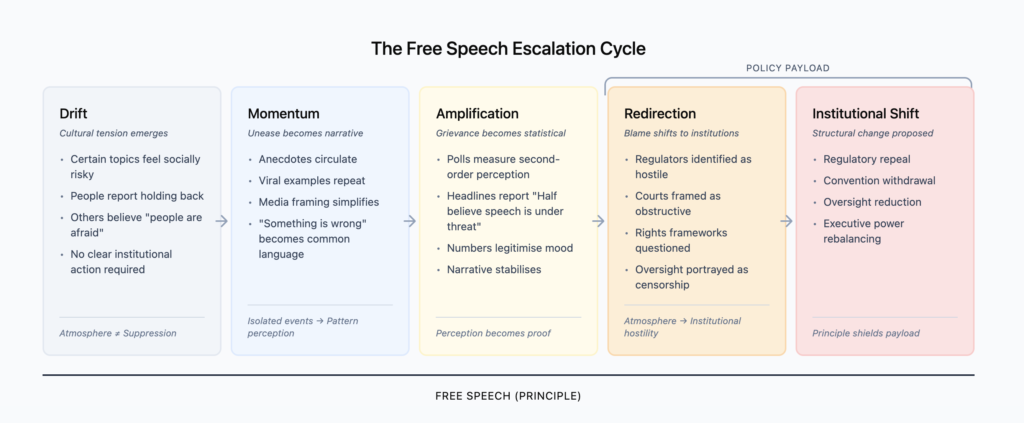
How a Clean Principle Can Carry a Heavy Payload
Free speech is one of the simplest ideas in democratic life.
It sounds uncomplicated:
You should be allowed to say what you think.
Most people agree with that instinctively.
It feels moral.
It feels protective.
It feels fair.
That is exactly why it is powerful.
And exactly why it can be used as a political delivery mechanism.
1. What the Evidence Actually Shows
Recent nationally representative research in England and Wales found something more nuanced than a crisis narrative.
People broadly support freedom of expression as a principle.
But when asked whether they personally feel able to speak freely, the answers vary sharply by topic.
On climate change and mainstream politics, most feel comfortable.
On immigration, religion, race, trans issues and Middle East conflict, many say they hold back.
When asked why, the most common reasons are not fear of arrest or state punishment.
They are:
Avoiding offence.
Avoiding arguments.
Avoiding social conflict.
That is not the same thing as legal suppression.
It is social friction.
Those two are often conflated.
2. The Perception Gap
There is a crucial difference between:
“I am afraid to speak.”
and
“I believe people are afraid to speak.”
The second spreads faster.
Second-order perception questions — “Do you think people are afraid…?” — measure atmosphere, not necessarily lived experience.
Atmosphere is politically useful.
If enough people believe there is a climate of silencing, it becomes:
“We are being silenced.”
That sentence does not require mass arrests.
It requires shared unease.
3. The Nostalgia Lever
When people are asked whether speech was freer 10 or 20 years ago, many say yes.
But 20 years ago:
Conversations were local.
Posts were not archived.
Employers did not scan your digital footprint.
Screenshots did not travel globally in seconds.
What feels like “more freedom” may partly be:
Less amplification.
Less permanence.
Less exposure.
Memory smooths edges.
Youth feels freer.
The past feels simpler.
Politics can build on that feeling.
4. The Broadcast Illusion
For most of human history, speech was local.
You learned to adjust what you said depending on:
Your friends.
Your parents.
Your boss.
The room.
Now a single post can reach millions.
Most people are still calibrated for the pub.
They are now operating on a global stage.
When consequences follow, it feels like censorship.
Often it is scale shock.
This distinction matters.
5. From Principle to Payload
“Free speech” is a high-status principle.
It attracts broad agreement across tribes.
That makes it an ideal umbrella.
Under that umbrella, political actors can bundle much larger structural proposals, including:
• Repealing or rewriting regulatory frameworks
• Withdrawing from international rights conventions
• Weakening oversight bodies
• Redesigning institutional constraints
• Expanding executive discretion
Those policies may or may not be justified.
But they are not identical to the principle of everyday speech.
The rhetorical move works like this:
- Establish a shared grievance about speech climate.
- Frame institutions as hostile.
- Present structural change as protection.
- Collapse debate into a moral binary: freedom vs control.
The clean moral language shields the institutional mechanics underneath.
6. Who Benefits?
Tradecraft does not assume conspiracy.
It asks about incentives.
If regulatory scrutiny weakens, who gains?
If oversight frameworks are dismantled, who gains?
If rights structures are exited or rewritten, who gains?
If a narrative of institutional hostility spreads, who gains politically?
Sometimes the answer is ideological.
Sometimes it is commercial.
Sometimes it is simply electoral.
In modern politics, actors often hedge.
Support flows in multiple directions.
Networks overlap.
Influence does not require illegality.
It requires alignment.
7. What the Data Supports — and What It Does Not
The strongest evidence currently available supports this:
There is measurable cultural tension around certain topics.
There are generational and social divides.
Many people report holding back in specific contexts.
The evidence does not support:
A blanket, centrally coordinated regime of mass speech prohibition.
That distinction is important.
Tension can be mobilised.
But tension is not tyranny.
8. The Discipline
The correct response is neither dismissal nor panic.
It is separation.
Separate:
Principle from policy.
Perception from prohibition.
Atmosphere from enforcement.
Narrative from mechanism.
If someone invokes “free speech,” the next question is simple:
What exactly are you proposing to change?
And who does that change empower?
If you are sure you have considered everything,
the rest is up to you.