
START HERE
How Not to Be Played
Most people don’t realise when they are being influenced.
Not because they’re stupid — but because the system is designed that way.
This is not about telling you what to think.
This is about showing you how thinking gets shaped.
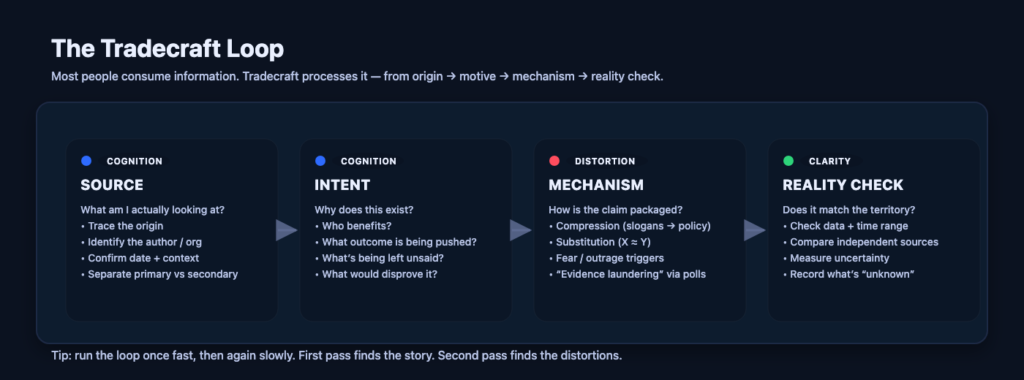
WHAT THIS COURSE IS
This is a practical framework for:
– understanding how information is presented
– spotting when meaning is being manipulated
– separating what is true from what feels true
You do not need to agree with anything here.
You only need to test it.
Cognitive Constraints (Non-Negotiable)
Tradecraft operates under three constraints.
They are not ideological.
They are cognitive realities.
1. Attention Is Finite
Humans do not process everything.
We process what stands out.
Emotion, novelty, threat and repetition dominate attention.
If you do not control attention, something else will.
Tradecraft therefore treats attention as a scarce resource — not a moral virtue.
2. Memorisation Is Not Understanding
Symbols can be repeated without being understood.
Passing a test does not prove comprehension.
Reciting a slogan does not prove truth.
If you cannot:
- explain it simply
- apply it to a real scenario
- predict a consequence
you do not understand it.
Tradecraft separates performance from comprehension.
3. The Learner Is Not a Brain in a Jar
Learning is not a neural download.
It is embodied, cultural, relational.
Tradecraft analyses structures —
but it never reduces people to biology.
Agency remains central.
This framework reflects the best structural understanding available at the time of writing.
It is open to revision.
If it fails under real-world pressure, it will be rebuilt.
Human judgement remains final authority
THE PROBLEM
You are told to:
“Do Your Own Research”
But in reality that often means:
– finding content that agrees with you
– trusting sources you already believe
– reinforcing conclusions you already had
That is not research.
That is confirmation.
THE STREET PROTOCOL
If you take nothing else from this course, take this:
TRACE IT
Where did this come from?
CHECK IT
What is actually being claimed?
CHALLENGE IT
What’s missing? What’s been left out?
BREAK IT DOWN
When you see a claim, don’t react to it.
Break it into pieces:
What actually happened?
Who is telling me this?
What are they leaving out?
What do they want me to feel?
THE SCISSOR TEST
If someone tells you:
“This thing must be banned because it can be abused”
Ask:
Can the same outcome be achieved using something simpler?
If the answer is yes —
then the problem is not the tool.
It’s the behaviour.
EXAMPLE
People say:
“AI is dangerous because it can create harmful images”
But:
So can Photoshop
So can editing software
So can a magazine and a pair of scissors
So what are we really dealing with?
Technology?
Or human intent?
KNOW YOUR LIMITS
This framework is not perfect.
It is based on:
– experience
– observation
– pattern recognition
There will always be things you don’t know.
There will always be things you get wrong.
That’s not failure.
That’s reality.
CONFIDENCE LEVELS
Not all knowledge is equal.
Ask yourself:
Did I see this myself?
Did I verify it?
Or did I inherit it?
There is a difference between:
“I know this happened”
“I think this happened”
“I was told this happened”
Most people live in the third category.
WHAT YOU ARE LEARNING
You are learning to:
– slow down reaction
– resist emotional shortcuts
– recognise narrative structure
– think before agreeing
That alone puts you ahead of most people.
FINAL RULE
You are not here to win arguments.
You are here to understand what is real.
NEXT STEP
Go to Lesson 1 — Source and Intent
[Continue : https://tradecraftagency.org/lesson-1/]